Why culture is a performance question
Most founders describe culture in words like trust, ownership and energy. Then they try to build it with tools that work against it: bonuses tied to targets, visible rankings, pressure from the top when the quarter looks tight.
You probably recognise some of these signals in your own company:
- People deliver exactly what was asked and nothing more.
- Good ideas come only from the leadership team.
- The best engineers stay quiet in planning, then leave within 18 months.
- Engagement scores look fine, but nobody changes course when the plan stops working.
None of these is a hiring problem. They are motivation problems. Research by Neel Doshi and Lindsay McGregor, authors of Primed to Perform, shows that why people work determines how well they work. It also shows that the leader closest to a team has more influence on that "why" than any company value on a wall.
This article explains their Total Motivation (ToMo) model, what it says about leadership styles, and one weekly habit you can start on Monday.
The six reasons people work
Doshi and McGregor open their Talks at Google session with an experiment on toddlers. A researcher drops an object, and the child can help pick it up. In the group that got no reaction, 89% kept helping. In the group that was praised, 81% kept helping. In the group rewarded with a toy, only 53% did. The reward meant to reinforce good behaviour cut it almost in half.
The same pattern shows up at work. Their model sorts the reasons people work into six motives.
Three direct motives raise performance. They come from the work itself:
- Play: the work is interesting to do. You learn, experiment and stay curious.
- Purpose: you value the impact of the work.
- Potential: the work moves you toward a goal you care about, such as who you want to become.
Three indirect motives lower performance. They come from outside the work:
- Emotional pressure: you work to avoid guilt, shame or letting someone down.
- Economic pressure: you work for the bonus, or to keep the job.
- Inertia: you no longer know why you are still doing it.
The effect is not equal. Play is the strongest positive motive, then purpose, then potential. Inertia is the most destructive. The authors combine all six into one score, Total Motivation (ToMo), which measures how strongly a culture drives the motives that lift performance.
One distinction from the talk matters for tech companies. The authors separate tactical performance, meaning how well you execute the plan, from adaptive performance: how well people diverge from the plan when reality changes. Indirect motives hit the second kind hardest, and scaling companies live on it.
What your leadership style does to your team
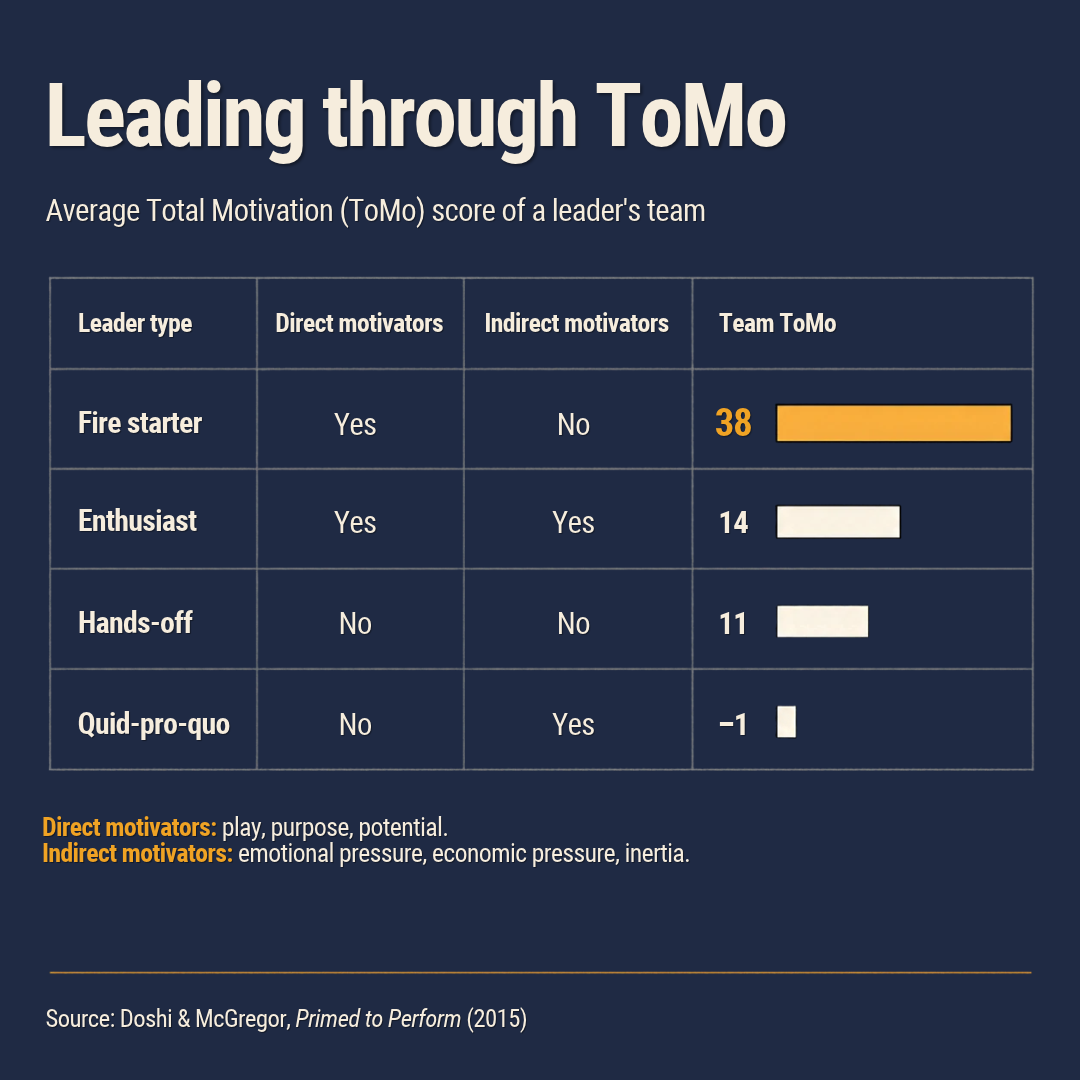
Doshi and McGregor compared leaders by how much they lean on direct and indirect motives, then measured the ToMo of the people who report to them.
Source: Talks at Google, Primed to Perform.
Two findings in this table should stop any founder.
Inspiration plus pressure does not add up. The enthusiast does everything the fire starter does, then adds carrots, sticks and emotional pressure. The team's ToMo falls from 38 to 14, close to a leader who does nothing at all.
Doing nothing beats carrots and sticks. The hands-off leader scores 11. The quid-pro-quo leader, who runs the team on bonuses and pressure alone, scores below zero.
The talk links this score to results customers feel. Across US airlines, which fly similar planes from similar terminals, ToMo tracked customer experience almost in a straight line. Southwest scored highest on both.
What fire-starter leaders do differently
In the talk, the authors put the question to every leader: are you on the journey to be a fire starter? A fire starter is not a personality type. It is a practice of asking, for every role and every week, three things: how do I make this work feel like play, how do I give it purpose, how do I connect it to potential? And what pressure can I remove?
In practice, that comes down to four habits.
- Design roles for play. The authors call role design the most powerful and most overlooked source of motivation. A role with room to experiment and solve problems drives play. A role reduced to executing someone else's checklist drives inertia.
- Connect work to visible impact. Purpose grows when people see who benefits from what they did. Share customer outcomes with the people who built them, not only with the leadership team.
- Make growth part of the job. Potential is not a promotion cycle. It is the next skill a person builds inside the role they already have. Our article on T-shaped development shows how to do this without new titles.
- Remove pressure you did not mean to create. Public rankings, last-minute escalations and "we can't afford to fail" messages all add emotional and economic pressure. Review which rituals add pressure but no learning.
Two more steps help scale these habits. Give the whole team the language of play, purpose and potential, so motivation becomes something you can discuss openly. And measure your team's ToMo, then use the result to start a conversation about culture, not to grade people.
Start with a 15-minute weekly huddle
The simplest way to start your fire-starter journey is the weekly reflection huddle that Doshi and McGregor run in their own firm. The whole team meets once a week, and everyone answers three questions:
- What did you learn last week? This builds play: learning, experimenting, curiosity.
- What impact did you have this week? This builds purpose.
- What do you want to learn next week? This builds potential.
A few rules keep the huddle useful:
- Keep it short. 15 minutes, every week, at the same time. Rhythm matters more than length.
- Leaders answer first, and honestly. If the founder only reports wins, the team learns that the huddle is a status update.
- No follow-up tasks in the room. The huddle is for reflection, not planning. Anything that needs action goes to a separate conversation.
- Listen for the gaps. If people struggle to name an impact, purpose is missing. If nobody learned anything, roles have no room for play.
After a quarter, the answers tell you more about your culture than an annual engagement survey. If your team struggles to answer one of the three questions, that is where your culture is leaking.
Where to go from here
A huddle starts the conversation. Changing how a team works usually needs two more things: managers who lead through play, purpose and potential, and a team that trusts each other enough to talk honestly about pressure.
- If your managers default to carrots and sticks, the fastest lever is the leadership layer. Our Leadership Development programmes combine coaching, action learning and shadow coaching, and measure what changed on the job, not what people thought of the workshop.
- If the team has stopped disagreeing out loud, start with the team itself. Building Strong Teams covers trust, productive conflict and resilience, using frameworks such as CliftonStrengths and The Five Dysfunctions of a Team.
Related reading on the SOTA blog:
Which of the three huddle questions would your team find hardest to answer?
Sources
- Neel Doshi and Lindsay McGregor, Primed to Perform: How to Build the Highest Performing Cultures Through the Science of Total Motivation. Harper Business, 2015.
- Neel Doshi and Lindsay McGregor, Primed to Perform | Talks at Google, YouTube, 16 November 2015. Source of the toddler experiment figures, the leader-type ToMo scores, the airline comparison and the weekly reflection huddle.