The phrase everyone has heard
The review went well. Targets hit, a feature shipped on time, two new hires onboarded without anyone asking. Then the manager says: "Great year. There's just no business need, and no budget for a promotion this cycle."
For the company, this is a payroll decision. For the employee, it lands differently. They don't hear "not now." They hear "there is no next step for me here." Some (usually the weakest ones) will stay and quietly lower their effort to match. The strongest will update their LinkedIn profile.
The real problem is even deeper. It creates the assumption that growth and promotion are the same thing. They are not, and treating them as one is one of the most expensive habits a scaling company can have.
The cost of the promotion bottleneck
Gallup's State of the Global Workplace 2026 report shows that only 20% of employees worldwide were engaged in 2025. That is the lowest level since 2020, and Gallup estimates it costs the global economy about $10 trillion in lost productivity.
Managers who are supposed to have growth conversations are struggling most. Manager engagement fell from 27% to 22%, the largest drop Gallup recorded.
The growth gap itself is not new: in Gallup's research on why people leave, career advancement and promotional opportunities are the top reasons, cited by 32% of leavers.
The fix looks obvious: promote more people. But Gallup draws a different conclusion. Development conversations do not have to be about pay or titles to matter. Growth can mean new skills, new teams, more autonomy, or mentoring someone else. Gallup also points to research suggesting that among disengaged employees, the most talented ones leave fastest.
In other words, people leave because they stop moving. A title is only one way to move.
Growth is a T, not a ladder
The ladder model has one direction: up. It needs an open seat above you, a budget line, and a business case. In a 120-person Series B company, those three rarely line up for more than a few people per cycle.
T-shaped growth works on two axes. The vertical bar is depth in your core discipline. The horizontal bar is breadth: adjacent skills that make you useful beyond your job description.
What this looks like in a tech company:
- A backend engineer learns product discovery and starts shaping what gets built, not just how.
- An HR business partner learns people analytics, or vibe-codes an internal tool that saves the team hours every week.
- A sales lead learns enough data skills to build the pipeline forecast instead of waiting for one.
- A team lead takes on mentoring two juniors and learns to coach before ever holding the title of manager.
Each new skill raises the person's market price, even when the title stays the same. That is the uncomfortable part for leaders. The skills you help people build are visible to every recruiter on LinkedIn.
But the alternative is worse. Companies that support T-shaped growth keep their top performers and high achievers in-house, because those people can see their value rising where they are. Companies that don't end up training people for competitors anyway, just more slowly and with less loyalty at the end.
What the leaders already do
LinkedIn's 2026 Talent Velocity Report names the capability behind T-shaped growth. It calls it talent velocity: an organization's ability to see its skills, build or acquire what it needs, and move people to where the work is, in real time. By that measure, 86% of companies fall short.
The pressure behind this is real. According to the report, 89% of talent leaders worry about skills agility and 88% worry about retention, even with slower hiring. And the No. 1 retention strategy they name is not promotion. It is providing learning opportunities, followed by coaching, mentoring, and internal mobility.
The gap between velocity leaders and laggards shows where the difference is made:
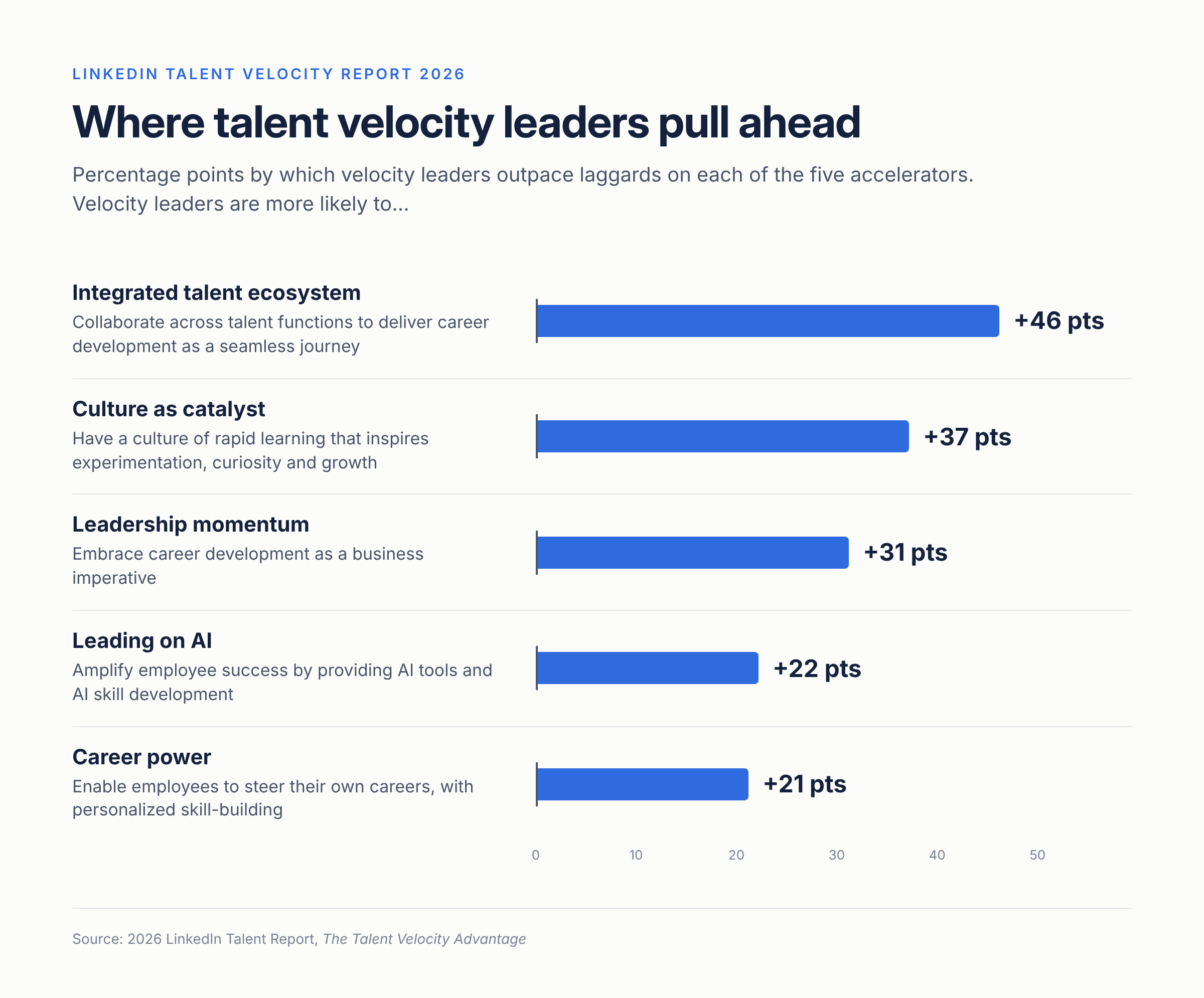
The largest gap is about managers, not budgets. And the report's principle for career growth reads like a direct answer to "no budget for promotion": in the leading companies, growth is driven by capability, not hierarchy.
One step forward. LinkedIn suggests starting small. Pick one job family, map the roles to the skills they need, and use that map for decisions on upskilling, career paths, mobility, and retention. For a 50–150 person company, that is a two-week exercise, not a transformation program.
Why it works: Total Motivation
In Primed to Perform, Neel Doshi and Lindsay McGregor describe six reasons people work. Three strengthen performance, and three weaken it. A culture with high Total Motivation (ToMo) maximizes the first group and minimizes the second.
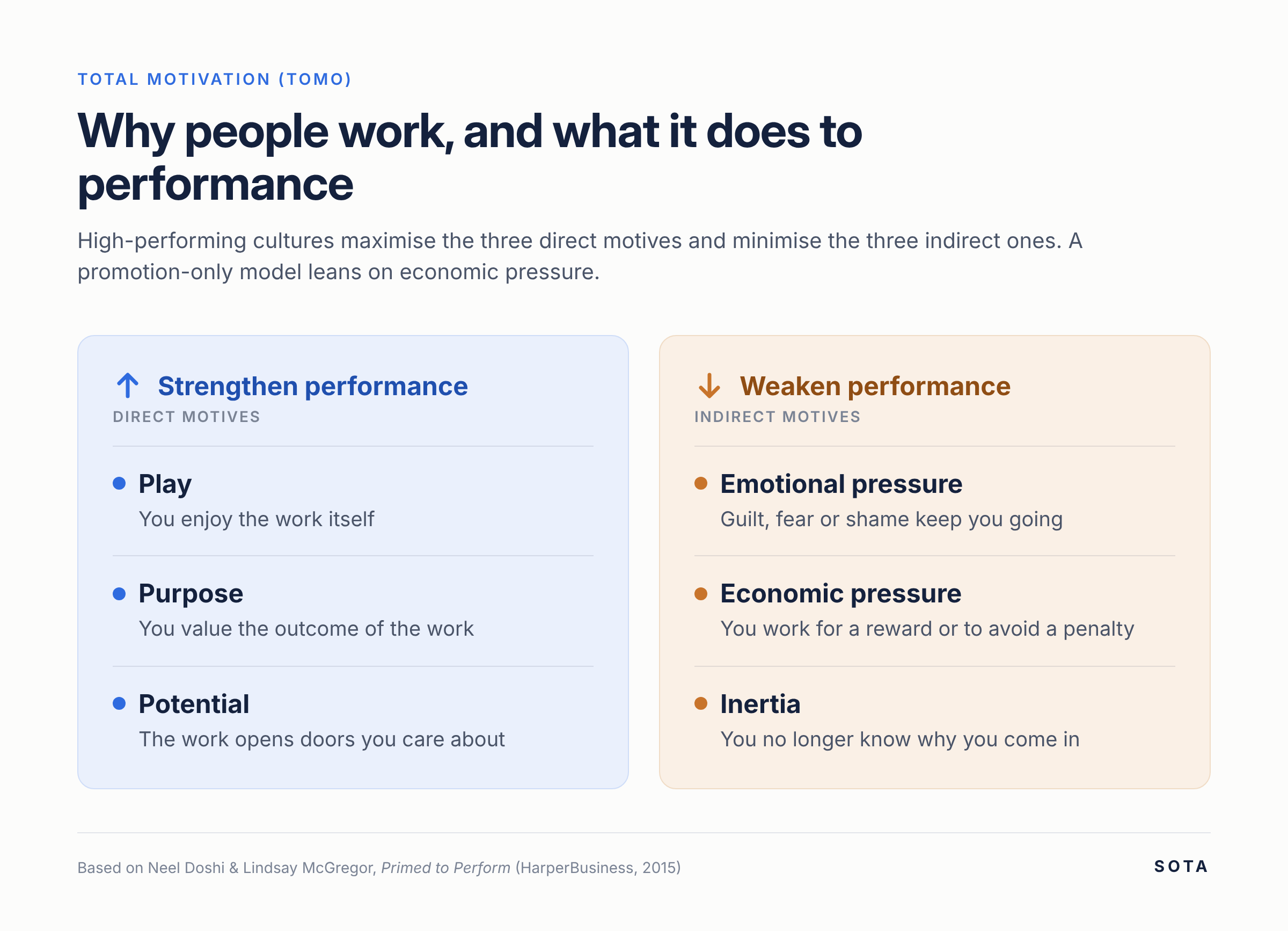
Now look at the promotion-only model through this lens. It runs almost entirely on economic pressure: hit the targets, get the title and the raise. When the reward is withheld "because there's no budget," nothing is left to replace it. Motivation drifts toward inertia.
T-shaped growth works on the other side of the table:
- Play. Learning something new is interesting in its own right. An engineer solving a discovery problem for the first time is curious, not compliant.
- Purpose. Broader skills let people see and shape the outcome of their work, not just their task in it.
- Potential. This is the strongest link. Every new skill is a door that work opens for the future, inside the company or outside it. People who can see that door are motivated to keep walking.
Doshi and McGregor also argue that role design is the most powerful, and most overlooked, source of Total Motivation. That is the practical takeaway for leaders. The title does not have to change. The role can.
Growth without a promotion budget: a playbook
None of these require a new budget line. They require managers who treat growth as part of the job.
- Put skills, not only titles, in every development plan. Each review ends with one or two skills the person will build next quarter, and how the work will give them room to practise.
- Create stretch projects and internal gigs. A two-month project in another team builds more breadth than a year of the same tickets. Publish these openings internally, like you would a job.
- Use rotations and shadowing. A week shadowing customer success or sales changes how an engineer or a designer thinks about the product.
- Run mentoring both ways. Seniors mentor juniors on the craft. Juniors teach leaders the AI tools they already use daily. Both sides grow.
- Make growth visible. Recognise a new skill in a team meeting or company update the way you would recognise a new title. What gets noticed gets repeated.
- Train managers to hold career conversations without a promotion to offer. This is where most companies fail. A manager who only knows how to talk about levels will go silent when there is no level to give.
Where to start
If any of these sound familiar, the promotion bottleneck is already costing you:
- Your performance reviews end with a rating and no plan for what the person will learn.
- Your best engineers became managers six months ago, and nobody has shown them how to have a career conversation.
- People who leave tell you in the exit interview or on Glassdoor that they "stopped growing".
- Every growth question in the company ends with the payroll analyses to decide who gets the next title.
At SOTA, we work with Series A–C tech companies on exactly this layer. As a fractional CHRO, we set up performance management, learning and development, and continuous feedback that make skills-based growth part of how the company runs. Through leadership development, we prepare managers to hold growth conversations when there is no promotion to offer. We assess where your leadership layer is before we start and measure what changed on the job afterwards. And because stretch projects, rotations and two-way mentoring only work when teams trust each other, we help build strong teams with shared goals, mutual trust, and clarity.
One question to take into your next round of reviews:
When did you last have a growth conversation with someone you can't promote this year?
Book a 30-minute call if you'd like to talk it through.
Sources
- Gallup, State of the Global Workplace 2026
- Gallup, Show your stars how they can grow with you
- Gallup 2022 poll on learning and growth, via CreditUnions.com
- Gallup reasons for leaving, via Inc.
- LinkedIn, 2026 Talent Velocity Advantage Report
- Neel Doshi and Lindsay McGregor, Primed to Perform (HarperBusiness, 2015); summaries via Porchlight and Dean Yeong