By Marina Stasevich
Updated October 21, 2026
Updated October 21, 2026
Short answer: Every team moves through five stages: forming, storming, norming, performing and ending. The leader's job changes at each one. Name the stage your team is in, pick the one thing it needs from you, and revisit it whenever people join or the direction shifts, because teams go back and forth between stages.
How Does a Group of People Become a Team?
In growth-stage tech companies, teams keep changing: new people join, the business direction shifts, projects end. Each change affects how the team works together. Having great individuals isn't enough. Teams are not stable; they continuously go through different stages of development.
One of the most commonly used models was created by Bruce W. Tuckman. It outlines five key stages: Forming, Storming, Norming, Performing, and Ending (sometimes referred to as Adjourning or Mourning).
One of the most commonly used models was created by Bruce W. Tuckman. It outlines five key stages: Forming, Storming, Norming, Performing, and Ending (sometimes referred to as Adjourning or Mourning).
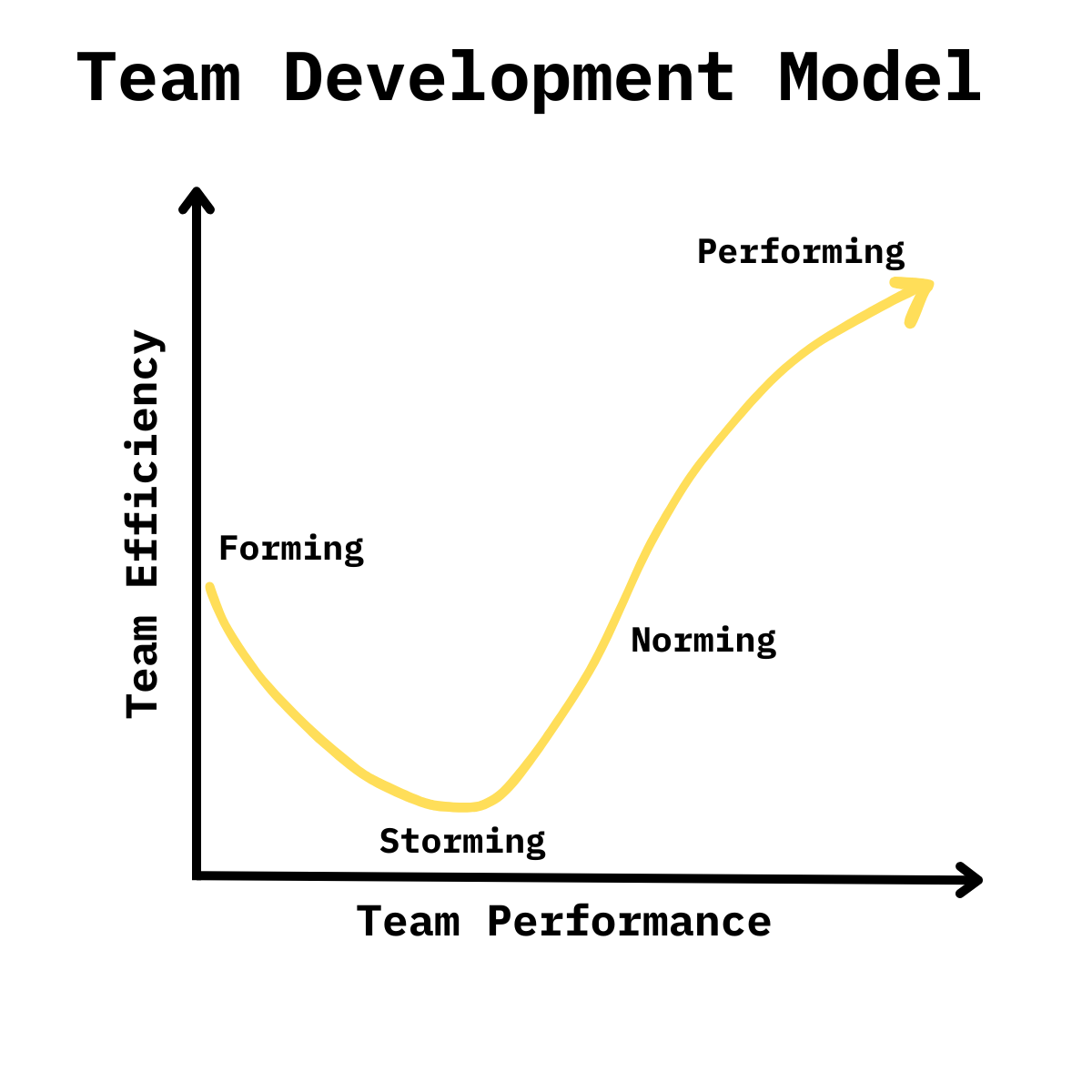
Understanding these stages helps team leaders and members:
- Manage the inevitable conflicts and changes during group development;
- Move through the stages with awareness and compassion for each other;
- Enhance overall team performance and create a healthy team culture.
Forming: What Does a New Team Need From Its Leader?
At the start, team members are often excited about working together. At the same time, some of them may feel anxious about fitting into the team or meeting expectations. Lots of questions arise, and team productivity might be low.
The key focus for team leaders at this stage is to onboard new members, create a clear structure, set goals, and align the team’s vision and values to build trust.
Trust is worth the effort. According to HBR, employees at high-trust companies are 50% more productive, 76% more engaged, and experience 40% less burnout than those at low-trust organizations.
Reflect with your team on these questions during the forming stage:
- Who are we as a team, and why are we here?
- Which goals and values unite us?
- Do we clearly understand our roles and responsibilities?
- Why is our work important? Who benefits from it?
- What are the ideal outcomes of our work?
A new or struggling operating team can start with Team Coaching and Facilitation: role alignment, decision-making principles and conflict resolution.
Storming: How Do You Handle Conflict in a Team?
At some point, you may notice employees pushing against the established boundaries. They may express concerns about goals, roles, efficiency, or ways of communicating within the team. They may become impolite to each other, argue, or challenge your management style. This is when initial excitement gives way to frustration and disagreement.
Conflicts are inevitable and normal on the path to improvement. To address and overcome frustration: review goals, roles, and tasks; establish norms for how team members will express disagreement constructively; and support a culture of open feedback.
Storming can break a team if team conflict is left unresolved.
Questions to work through during the storming stage:
- How do we give and receive feedback?
- What do we do when someone breaks an agreement?
- How do we prevent and solve problems effectively? What do we rely on to do so?
- How do our differences make us a strong team?
When the same blockers keep coming back, the 5 Dysfunctions of a Team assessment and workshop looks for the root cause. It is based on Patrick Lencioni's model of trust, conflict, commitment, accountability and results, and helps the team commit to new ways of working.
Norming: How Do You Turn Agreement Into Working Habits?
At this point, employees start to resolve their differences and align their individual expectations with the team's reality. Team efforts consciously focus on achieving harmony, meaningful communication, and an increased acceptance of diverse opinions. Team leaders can encourage constructive feedback and evaluate processes and productivity.
Use your regular one-on-ones to encourage individuals to share their opinions of what’s going on and what needs to be done to advance.
Use your regular one-on-ones to encourage individuals to share their opinions of what’s going on and what needs to be done to advance.
Questions for team leaders to reflect on during the norming stage:
- How can we encourage meaningful communication with each other?
- What initiatives can we pursue to promote and support the variety of opinions within the team?
- How do we evaluate our processes and productivity?
- What is the real strength of each team member? Which skills and competencies do we lack, and how can we access them by working as a team?
Team's Superpowers, a workshop based on the Gallup CliftonStrengths assessment, helps teammates understand each other's operating style and what they need from others to perform well. Anna, HRD at Symfa, on a StrengthsFinder session with her team: “the team was thrilled, we learned about each other from a new angle”.
Performing: How Do You Sustain a High-Performing Team?
In this stage, you will notice peak performance: your team is in flow. Team members work hard, feel satisfied, share insights, and adopt a “can-do” attitude with an appreciation of differences that boosts overall productivity.
As a leader, make time for each employee's personal development. Discuss with your team the opportunities and resources that are available to them and what kind of support employees expect from you.
As a leader, make time for each employee's personal development. Discuss with your team the opportunities and resources that are available to them and what kind of support employees expect from you.
Reflect on these questions to advance further:
- How can individual strengths be put to work for collective progress?
- How can roles become more fluid, with members taking on responsibilities as needed?
- How do we know that we are moving in our chosen direction? How do we measure goals and criteria? How often?
- How do we recognize and celebrate our accomplishments?
High-growth phases are also when burnout starts. Thriving Team is a well-being and stress-management workshop that covers stress physiology and day-to-day resilience strategies.
Ending: How Do You Close a Project Without Losing the Team?
When projects come to an end, team members may feel mixed emotions, from satisfaction to anxiety and sadness. Some people who developed close working relationships with colleagues may find this time difficult. The focus on tasks decreases because people feel uncertain about what’s ahead.
Team leaders play a big role in managing emotions, keeping team members focused on tasks for a smooth transition, and creating a meaningful closing celebration. Having positive shared experiences will make things easier if you work with some of the same people again in the future.
Team leaders play a big role in managing emotions, keeping team members focused on tasks for a smooth transition, and creating a meaningful closing celebration. Having positive shared experiences will make things easier if you work with some of the same people again in the future.
Questions that help overcome the emotions of the adjourning stage:
- How can we manage conflicting emotions?
- What tasks are crucial for a smooth transition?
- What are the “lessons learned”?
- How can we create a meaningful closing celebration?
How Do You Use the Team Development Model?
One of the key roles of a leader is to help the team smoothly advance to the performing stage. Recognizing and understanding the stages can help leaders choose suitable development techniques. Follow the steps below to ensure that you're doing the right thing at the right time:
- Identify your team’s current stage.
- Consider what you need to do to move on to the next stage.
- Follow your action plan.
- Regularly review where your team is and adjust your behavior and leadership approach accordingly.
Can a Team Go Back to an Earlier Stage?
The process may not be straightforward or linear. Teams may go back and forth between stages. When new members join, for example, teams might go back to the “Forming” stage. A new business direction might require you to reevaluate your team roles and goals. Continually reflect on which stage your team is at and make changes to get back on course as necessary.
Which Team Format Fits Your Situation?
SOTA runs five team formats for tech companies, online or on-site:
Not sure which stage your team is in? Book a team assessment to identify what's holding the team back.
- Team's Superpowers. A workshop and team coaching based on Gallup CliftonStrengths. Half-day or full-day; ideal for mid-size to large teams with a lot of cross-functional collaboration.
- Thriving Team. Well-being and stress-management training to prevent burnout during high-growth phases. Half-day workshop.
- Cross-cultural Team Workshop. How culture shapes communication and decision-making, for teams working across cultures. One-day or half-day.
- 5 Dysfunctions of a Team. Assessment and workshop based on Patrick Lencioni's model. Half-day, full-day or two-day; ideal for small, close-working teams such as executives and cross-functional operating teams.
- Team Coaching and Facilitation. Custom work on role alignment, decision-making principles and conflict resolution, for a new or struggling operating team. At least three team sessions.
Not sure which stage your team is in? Book a team assessment to identify what's holding the team back.
Related reading
Team-Building That Actually Works for Scaling Tech Teams — five structured team-building formats.
Case Study: Developing First-Time Managers at G-Core Tashkent — how SOTA developed first-time managers.
Case Study: Developing First-Time Managers at G-Core Tashkent — how SOTA developed first-time managers.
FAQ: Team Development Stages
What are the five stages of team development?
In Bruce W. Tuckman's model: Forming, Storming, Norming, Performing and Ending (sometimes referred to as Adjourning or Mourning).
Can a team go back to an earlier stage?
Yes. When new members join, a team might go back to the forming stage, and a new business direction might require you to reevaluate roles and goals. Storming can break a team if team conflict is left unresolved.
How do you handle conflict in the storming stage?
Treat conflict as normal on the path to improvement. Review goals, roles and tasks, establish norms for how team members express disagreement constructively, and support a culture of open feedback.
When does a team need outside facilitation?
Team Coaching and Facilitation works best with a real operating team that is new or needs a fresh start, or one facing performance, accountability or hidden-conflict issues.
Can team workshops run online?
Yes. SOTA delivers workshops, follow-up work and on-the-job support online or on-site.
SOTA is a boutique fractional CHRO and business strategy consultancy serving international tech companies across Cyprus, Europe, UK, and UAE. We specialize in scaling the people side of your business — from building leadership teams and establishing HR functions to facilitating strategic alignment — so you can grow faster without the overhead of a full-time executive hire. We help scaling organisations build the people infrastructure and strategic clarity they need to grow — in English and Russian. If team and leadership development is a challenge you're navigating, explore our team development services or leadership development or book a call with us.