The rise of the Talent Market Strategist
When Google posts a new role, it’s often a signal of what’s next for the rest of the market. One of their latest job postings — Talent Market Strategist — reflects a growing global trend: talent acquisition is shifted from an operational function into a strategic, market-driven discipline.
This role is not about filling today’s openings. It’s about anticipating future hiring needs, understanding how market shifts, competition, and compliance that affects talent availability, and building proactive strategies that ensure long-term growth.
In other words, talent strategy is finally catching up with business strategy.
What does a Talent Market Strategist do?
At Google, the Talent Market Strategist connects business leaders, recruiters, and people partners to shape the company’s long-term workforce plan. Their responsibilities go far beyond recruitment:
- Forecasting hiring demand based on business growth and new market entry.
- Analyzing market data to identify where critical talent is located and what it will take to attract them.
- Designing scalable, localized hiring programs that comply with local regulations and align with company culture.
- Optimizing ROI by measuring the effectiveness of every sourcing channel and budget line.
It’s part data science, part strategy, part people operations, and entirely about connecting business ambition with real-world talent capacity.
Why this matters beyond Google
The creation of this role signals a broader shift in how companies should think about growth.
For years, hiring was treated as an HR process. However, with the pressure to scale quickly and compete for talent (especially in tech), organizations are now realizing that talent availability defines how fast they can grow.
What this trend means for technology scale-ups
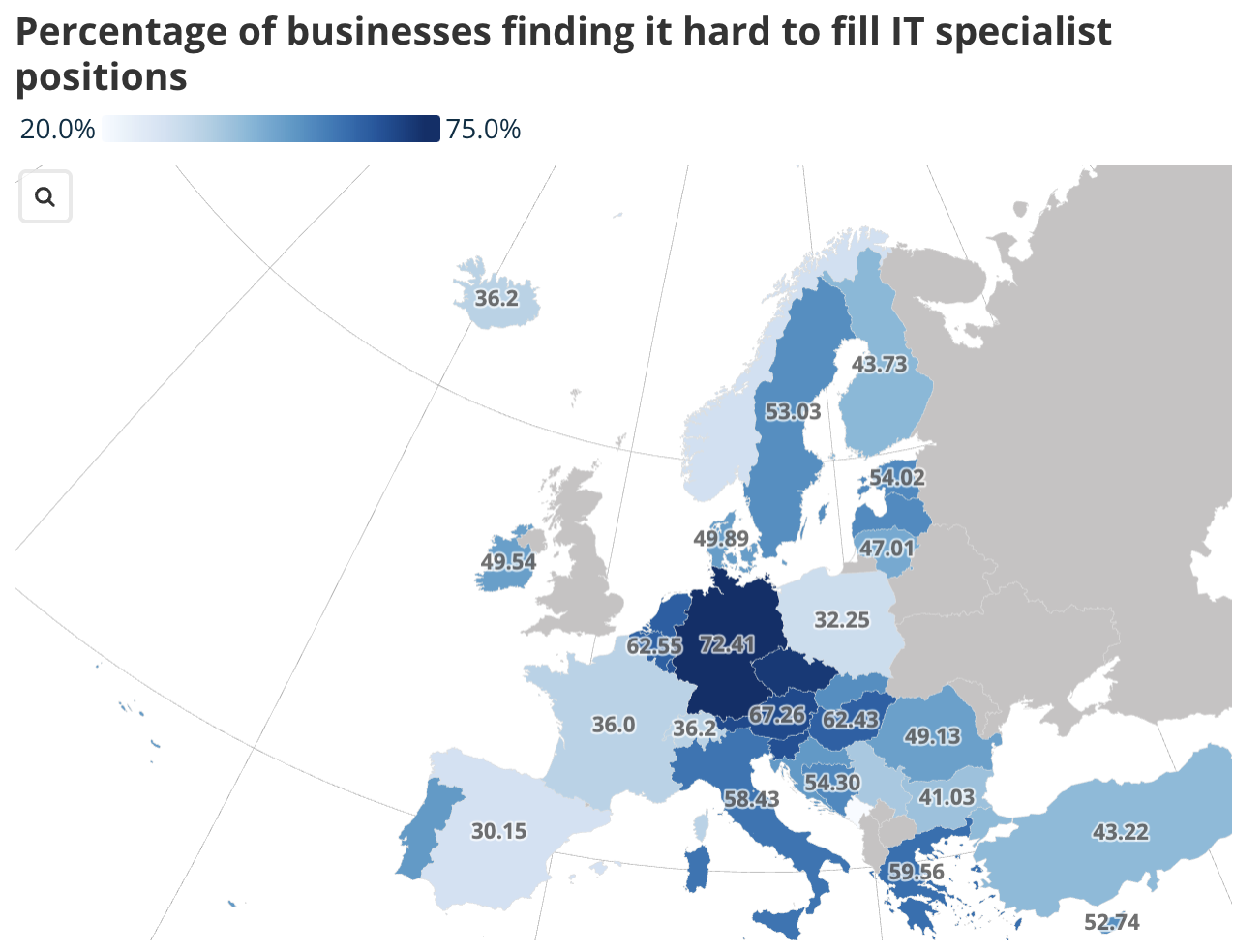
Startups rarely have the luxury of a full-time “Talent Market Strategist.” Yet they face the same challenges:
- limited talent pools in target geographies,
- intense competition with better-known brands,
- and a high risk of over-hiring or under-hiring as the business scales.
Source: Eurostat (2024)
How SOTA helps startups build their own Talent Market Strategy
At SOTA, we work with scaling tech companies that need to grow smarter, not just faster. Recently, we created Talent Market Strategy for a fintech startup to help make data-backed decisions about how and where to build their teams and how to improve their hiring pace.
Here’s how we did it:
1. Market Mapping & Forecasting
We analyzed talent availability, skill distribution, and demand across target markets to identify where the best hiring potential lies and what’s realistic within the next 6 -12 months.
2. Efficiency & ROI Audit
We evaluated the efficiency of their current sourcing channels, hiring processes, and employer brand, and designed strategies to improve offer acceptance, employer brand visibility, and retention.
3. Actionable, Scalable Plan
The result isn’t a report that sits on a shelf. It’s a practical roadmap with prioritized actions, timelines, and metrics that track how well your hiring engine is performing against business growth goals.
We analyzed talent availability, skill distribution, and demand across target markets to identify where the best hiring potential lies and what’s realistic within the next 6 -12 months.
2. Efficiency & ROI Audit
We evaluated the efficiency of their current sourcing channels, hiring processes, and employer brand, and designed strategies to improve offer acceptance, employer brand visibility, and retention.
3. Actionable, Scalable Plan
The result isn’t a report that sits on a shelf. It’s a practical roadmap with prioritized actions, timelines, and metrics that track how well your hiring engine is performing against business growth goals.
From reactive hiring to proactive growth
The biggest takeaway is simple: you can’t scale what you don’t plan for.
Even the best product or funding round can be slowed down by a weak hiring strategy or poor market visibility.
Data-driven workforce planning, localization, and employer brand positioning are no longer “nice to haves.” They’re becoming a core strategic capability not only for global giants but also for fast-scaling startups.
Interested in designing your startup’s Talent Market Strategy?
Let’s connect and build a roadmap that aligns your business growth with real-world talent potential.